The Great Desert
The Horse and His BoyThe Great Desert is both a formidable natural barrier and a route through which the fate of Archenland can be changed. Its open sands threaten travelers with distance, heat, and thirst; knowledge of a concealed valley, however, offers a way across that an invading army might also use.
Setting and Strategic Geography
The desert lies between Calormen and Archenland, with the Tombs of the Ancient Kings marking the starting point of a little-known western route. A raven who had flown widely over the region explains that an army could not reach Archenland by way of the Great Oasis: its springs would not supply enough water for all the soldiers and their animals. The alternative route begins at the Tombs, runs northwest with the double peak of Mount Pire straight ahead, and reaches a narrow, nearly invisible stony valley after a day’s ride or a little more. The valley initially appears to offer neither grass nor water, but following it downward leads to a river that runs into Archenland.
That geographical knowledge has military consequences. Rabadash argues that Narnia is small and could be conquered in five weeks by a thousand spears; the Tisroc’s court dismisses its freedom as disorder rather than treating it as a legitimate political choice. Against this imperial confidence, the Raven’s account makes the desert’s water supply and concealed passages decisive practical obstacles. The same terrain that can frustrate an army also gives a small party a possible route to safety.
The Fugitives’ Crossing
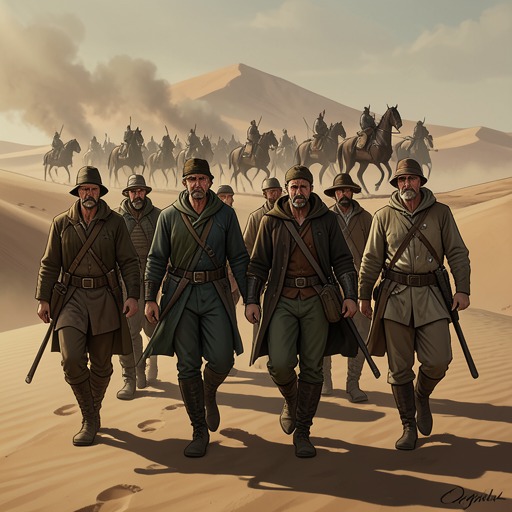
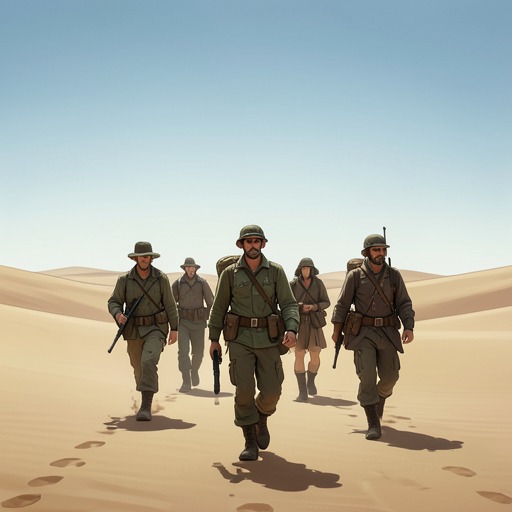
Shasta, Bree, Aravis, and Hwin set out at night, with Bree rejecting the storybook notion that horses can gallop for a day and a night without rest. They use brisk trots and short walks, and the humans dismount when the horses walk. At first the moonlit sand shines like smooth water or a silver tray, and the cool air makes the journey seem almost easy. Darkness and fatigue then replace that promise: the moon disappears, the landscape becomes a vast gray emptiness, and Shasta grows cold and thirsty as the hoofbeats sound dully against the dry sand.
Morning brings a brief lift in spirits. The sun turns the sand yellow, and Mount Pire’s double peak flashes ahead; Shasta notices that the party has drifted off course and calls for them to bear left. Tashbaan already looks small behind them, but it does not seem to recede as they continue. The glare hurts Shasta’s eyes, and the exposed sand becomes dangerously hot. When he dismounts, it burns his bare feet so badly that he scrambles back onto Bree. Aravis, walking beside Hwin, can keep going because she has shoes; Bree tells Shasta to remain mounted.
The Hidden Valley and Its Water
The party eventually reaches the valley, where steep rock walls and poor light make the narrow way feel more oppressive than the open desert. Its bends repeatedly conceal what lies ahead. The ground changes from sand to stones, and prickly plants and coarse grass appear, but water remains elusive. As the horses tire, Hwin stumbles and falls behind Bree; the travelers are nearly despairing when they find first a muddy trickle, then a brook, and finally a stream that grows into a river.
At the river, a little cataract pours into a broad pool. The horses are already drinking when Shasta slips down and plunges into the knee-deep water beneath the falling stream. The relief is the emotional counterweight to the crossing’s long ordeal: after thirst, burning sand, and repeated disappointment, water is not merely a resource but a moment of release. Once they emerge, the moon reveals soft grass beside the river and trees and bushes rising toward the cliffs. Too exhausted to speak or eat, the party lies down to rest.
Narrative and Thematic Significance
The desert’s significance rests on the gap between apparent emptiness and hidden passage. From the surface, the western route offers no visible promise of water or shelter; survival depends on knowing where to look and continuing through the valley despite its forbidding first impression. That pattern links the Raven’s strategic description to the fugitives’ bodily experience: a route discussed as a matter of military geography becomes, step by exhausting step, a question of whether the travelers can reach water.
The crossing also tests the party’s different capacities without making endurance a simple measure of worth. Shasta can read the direction of Mount Pire and correct their course, but his bare feet cannot withstand the heated sand. Bree sets a practical pace and adapts when Shasta can no longer walk. Later, after a lion attacks, Bree says he is fit only for slavery because he fled while the others were in danger; he contrasts his flight with Shasta’s return toward them. The desert crossing and its aftermath thus place physical hardship alongside moral self-judgment, while the route toward Archenland carries the fugitives out of Calormen and into the events that threaten the country ahead.